Choosing an Aluminium Washroom Door manufacturer involves more than comparing prices or browsing polished product photos. Global buyers need doors that suit daily traffic, moisture exposure, cleaning routines, and local project requirements. A thin panel may look neat in a showroom but feel less convincing after repeated use. Details matter.
This guide introduces manufacturers serving international projects and explains what buyers can assess before requesting a quotation. Look for clear information on aluminium profiles, panel thickness, finishes, hardware, dimensions, and available customization. Ask how products are inspected and packaged, and whether the supplier can provide relevant technical documents. Requirements differ by destination, so buyers should confirm applicable standards with qualified local professionals rather than assume one specification fits every market. Small checks can prevent costly delays.
A strong supplier should answer practical questions with specific, consistent information. Can the factory share drawings, samples, or recent project references? Are lead times and replacement-part arrangements explained in writing? These points reveal more than a broad claim of “premium quality.” Still, no checklist can replace a careful review of the actual product. Finishes can vary, and online descriptions rarely show every limitation. This comparison is designed to help buyers shortlist credible manufacturers, verify claims, and choose doors suited to their buildings—not simply the most attractive catalogue.
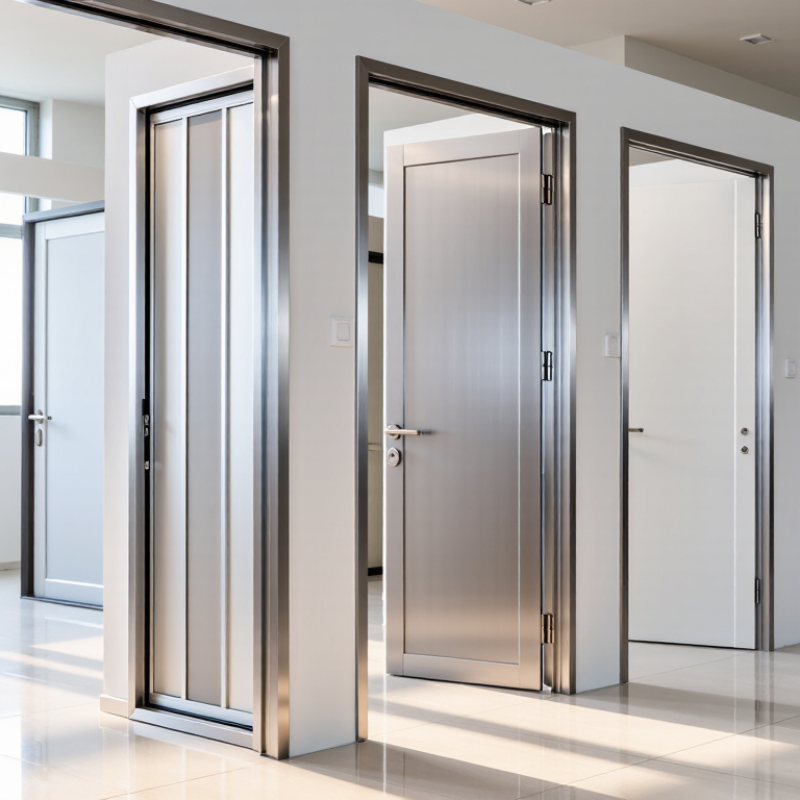
Aluminium washroom doors suit busy facilities where moisture, frequent cleaning, and daily traffic challenge ordinary materials. Common types include hinged doors for standard cubicles, sliding doors for narrow layouts, and folding doors where clearance is limited. Full-height panels offer more privacy, while shorter cubicle doors can support airflow and easier supervision in appropriate settings. The right choice depends on room dimensions, user needs, and cleaning routines.
A well-made door usually has a corrosion-resistant aluminium frame, stable infill panels, and hardware designed for repeated use. Smooth edges help reduce snagging, and simple hinges are easier to inspect when they begin to loosen. Finishes may include powder coating or anodising, with colour selected to suit the interior. Still, no finish is maintenance-free. Water spots and cleaning residue can collect near handles and lower edges, so regular wiping matters.
These doors appear in schools, offices, shopping centres, transport facilities, and healthcare buildings. In a compact office washroom, a sliding panel can preserve space around sinks and hand dryers. A sports facility may favour robust hinged doors that tolerate heavy daily use. Specify ventilation gaps, privacy levels, lock indicators, and accessible clearances before ordering. Measure the finished opening, not just the drawing; site conditions sometimes differ. That detail is easy to miss.
A practical comparison of common aluminium washroom door configurations, typical features, applications, and purchasing considerations. Specifications vary by project and supplier.
| Door type | Typical construction | Common features | Typical applications | Key buyer considerations |
|---|---|---|---|---|
| Aluminium-framed swing door | Aluminium perimeter frame with a solid, laminated, or glazed infill panel | Hinged operation; can be configured for inward or outward opening; supports a range of privacy hardware | Office washrooms, schools, hotels, retail buildings, and public facilities | Confirm opening direction, clear opening width, frame finish, hinge capacity, and compatibility with the wall construction |
| Aluminium-framed sliding door | Framed panel running on a top track, with a floor guide where required | Reduces the swing area required; suitable for layouts where circulation space is limited | Compact washrooms, accessible layouts where permitted by local requirements, and some residential projects | Check track capacity, wall space for the open panel, privacy, soft-close options, and accessibility requirements |
| Aluminium toilet cubicle door | Door leaf, pilasters, and hardware assembled as part of a cubicle partition system | Privacy latch, indicator bolt, hinges, and coordinated cubicle fittings may be specified | Public toilets in transport hubs, shopping centres, workplaces, and leisure facilities | Review cubicle layout, floor clearance, hardware durability, cleaning access, and replacement-part availability |
| Aluminium-framed glazed door | Aluminium frame with safety glazing selected for the project and local regulations | Allows light transmission; glazing can be clear, translucent, or patterned for privacy | Hotel and office washrooms, premium commercial interiors, and shared vanity areas | Specify privacy level, glazing type and thickness, edge protection, and applicable safety-glazing compliance |
| Ventilated aluminium door | Aluminium-framed leaf with louvres or ventilation openings | Provides an airflow path; opening design can be selected to balance ventilation and visual privacy | Utility washrooms, service areas, and facilities where mechanical or natural ventilation is planned | Coordinate free airflow area with the ventilation design; confirm louvre orientation, cleanability, and privacy needs |
| Aluminium door with solid infill | Aluminium frame combined with a solid panel, such as a project-specified compact laminate or other suitable infill | Provides an opaque surface; panel material and edge treatment affect moisture resistance and maintenance | High-traffic public washrooms, educational buildings, and commercial facilities | Confirm panel material, thickness, edge sealing, impact resistance, finish, and suitability for the expected cleaning routine |
| Custom-size aluminium washroom door | Made-to-order frame and leaf dimensions, hardware, and infill selected for the opening | Can accommodate non-standard openings, finishes, and project-specific hardware schedules | Renovations, hospitality projects, and buildings with unusual layouts | Provide verified site measurements, tolerances, drawings, finish samples, and a clear installation sequence before production |
Global sourcing checklist: Ask suppliers for dimensioned drawings, material and finish details, hardware schedules, packing specifications, installation instructions, lead times, and documentation relevant to the destination market. Confirm that the complete door assembly meets the project’s accessibility, safety, ventilation, and building-code requirements.
Request alloy details, frame thickness, panel thickness, and surface-treatment specifications. Ask for coating or anodizing samples. A sample corner helps. It can reveal weak joints, rough edges, or poor alignment.
Request evidence from completed projects with similar dimensions and humidity levels. Review maintenance records and replacement procedures. Ask for physical samples, not only photographs. Pictures can hide small defects.
Check hinges, locks, handles, fasteners, and their moisture resistance. Confirm compatibility with frequent cleaning. Ask how replacement parts are supplied. Tiny hardware failures cause major delays.
Confirm door width, height, swing direction, hinge positions, privacy gaps, and floor clearance. Measure uneven openings carefully. Ask who approves the final dimensions. A ten-millimetre error can disturb the entire cubicle line.
Give every supplier identical opening sizes, finish expectations, and hardware requirements. Compare packaging, drawings, spare parts, inspection records, and delivery terms. Read every line. A low quotation may exclude essential items.
Ask for drawings showing lock placement, edge treatment, ventilation gaps, and clearance beneath each door. Consider accessibility requirements and uneven floors. Request a mock-up for unusual sizes. It feels slower, but it exposes weak assumptions.
Confirm moisture protection, corner guards, pallet labels, and complete packing lists. Number the panels and match them with installation drawings. Clarify insurance, port duties, and delivery responsibilities in writing. Customs rarely follows perfect schedules.
The manufacturer should explain tolerances, repair procedures, and hardware kits clearly. Ask who resolves defects after delivery. Local installers must verify accessibility and building requirements. Communication matters. Still, clear answers do not guarantee flawless work.
Aluminium Washroom Door systems are valued for their corrosion resistance, lightweight structure, easy maintenance, and flexible design options. This article explains common types, including framed, frameless, hinged, sliding, and cubicle-compatible doors, as well as their typical use in commercial buildings, public facilities, hotels, offices, healthcare spaces, and transport locations. It also outlines important manufacturing standards, such as dimensional accuracy, surface treatment, hardware durability, safety performance, and resistance to moisture and daily wear.
For global buyers, selecting a reliable manufacturer requires careful evaluation of production capacity, quality control, customization services, certifications, communication, lead times, and after-sales support. The article further compares manufacturers according to regional market strengths and technical capabilities while addressing international purchasing considerations, including material specifications, color and hardware choices, packaging, shipping documents, import requirements, installation guidance, and project coordination. These factors help buyers make informed decisions and achieve consistent quality, efficient delivery, and long-term performance.

 Astris Window Systems