An Aluminum Bathroom Door is more than a sleek replacement for timber or PVC. It is a practical answer to steam, splashes, tight floor plans, and repeated daily use. Aluminum resists moisture, does not swell like untreated wood, and can support slim frames around frosted, clear, or patterned glass. That matters in a bathroom where water often reaches the lower edge first. The surface can also be powder-coated in white, black, bronze, or custom colors. Small details change the experience.
Architect Ludwig Mies van der Rohe’s principle, “Less is more,” offers a useful way to understand this choice. A well-designed Aluminum Bathroom Door can provide strength without visual heaviness. Yet minimal does not mean maintenance-free. Hinges still need inspection, seals can harden, and poor installation may allow water to reach the wall. This is where product quality and installer experience become important. A carefully measured frame should sit square, close quietly, and leave enough clearance for cleaning. Otherwise, even an attractive door becomes frustrating.
Think about the morning routine: wet hands, warm air, and a door used dozens of times. Aluminum handles that situation well when the alloy, coating, hardware, and glass are matched correctly. It is not always the cheapest option. Sometimes, another material may suit a dry, low-use bathroom better. Still, for durability, clean lines, and moisture resistance, an Aluminum Bathroom Door deserves serious consideration. The best decision begins with honest site conditions, not appearance alone.
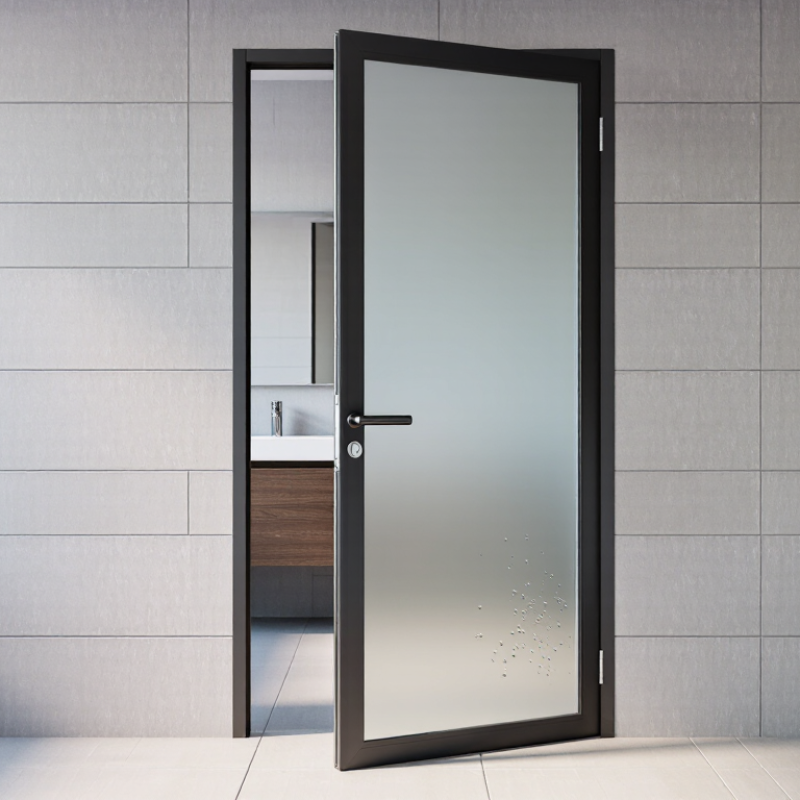
An aluminum bathroom door is a door system built with aluminum frames, panels, or both. Aluminum’s density is 2.70 g/cm³, making it much lighter than steel. This lower weight can reduce strain on hinges, frames, and walls during daily use. Installation also feels easier when carrying the door through narrow hallways.
In humid bathrooms, aluminum develops a thin oxide layer that helps resist corrosion. It does not behave like ordinary untreated steel near steam, splashes, and wet floors. A properly finished surface also feels smooth and is easier to wipe clean. Still, aluminum is not automatically waterproof. Water can enter through poor joints, damaged coatings, or badly sealed edges.
A reliable aluminum bathroom door needs more than a light frame. Look for sturdy hinges, accurate corner connections, drainage details, and suitable seals. These parts affect noise, privacy, and long-term movement. I have found that weak hardware can make a good aluminum door feel disappointing within months. That is easy to overlook.
Aluminum also has limits. It transfers heat readily and may provide less sound insulation than a heavier composite door. A hollow panel can sound sharp when closed. Choosing a filled panel, tight seals, and careful installation can improve the experience. The best choice depends on moisture exposure, ventilation, privacy needs, and the quality of construction.
An aluminum bathroom door uses an aluminum frame, usually paired with tempered glass, acrylic, or another moisture-resistant panel. The frame’s performance depends heavily on its alloy and temper. 6063-T5 is a popular choice because it combines low weight with useful structural rigidity.
The alloy contains magnesium and silicon, then receives heat treatment and artificial aging. This process improves its strength after extrusion. The result is a frame that feels easy to handle but resists bending during daily use. It can support hinges, seals, and door hardware without the heavy bulk of steel. That matters during installation.
It feels light.
In a humid bathroom, 6063-T5 aluminum also offers strong resistance to rust. Its surface remains stable around steam, splashes, and frequent cleaning, although poor drainage can still damage nearby hardware. The frame should be cut accurately, joined tightly, and installed with suitable seals. Small gaps may invite water into the wall or floor.
A common mistake is treating aluminum as maintenance-free. It is not. Scratches, loose screws, and worn seals need attention. Thermal movement can also affect alignment in rooms with sharp temperature changes. Regularly checking the hinges and bottom track keeps the door operating smoothly. The material is reliable, but the installation still decides much of its real-world performance.
What Is an Aluminum Bathroom Door and Why Choose One?
Why Aluminum Resists Bathroom Moisture and Corrosion Under AAMA 2604
Bathroom air carries moisture into hinges, corners, joints, and coating edges. Aluminum forms a thin oxide film naturally, which slows further corrosion. That protection is useful, but it is not unlimited.
The U.S. Environmental Protection Agency recommends indoor relative humidity between 30% and 50%. Poor ventilation can push bathroom surfaces far beyond that range. AAMA 2604 evaluates high-performance organic coatings through humidity, salt-spray, weathering, adhesion, and chemical-resistance tests. These tests help verify how a coated aluminum door handles demanding conditions. AAMA 2604 is not a blanket guarantee.
The NACE IMPACT study estimated global corrosion costs at about 3.4% of worldwide gross domestic product. That figure explains why small details matter. A properly finished aluminum door should have sealed edges, clean drainage paths, and compatible fasteners. Otherwise, trapped water may attack cut edges or create galvanic corrosion around screws.
In practical use, wipe mineral deposits from the lower rail. Keep the exhaust fan running after showers. It helps.
A weak point remains. Even a compliant coating can fail when scratched, poorly installed, or neglected. I would inspect the bottom corners twice yearly, especially where water collects. A careful installer should also confirm that the coating system, substrate preparation, and hardware meet the project’s AAMA 2604 requirements.
| Data Dimension | Verified Material or Performance Fact | Bathroom Application Relevance | Assessment |
|---|---|---|---|
| Basic Definition | An aluminum bathroom door typically uses aluminum profiles for the frame, with a door panel made from glass, aluminum, or another compatible infill material. | The aluminum frame provides a lightweight, non-porous structural component suitable for humid interior spaces. | Suitable |
| Moisture Absorption | Aluminum is a metal and does not absorb water in the way that untreated wood-based materials can. | The frame is less likely to swell, warp, or lose dimensional stability because of routine bathroom humidity or water splashes. | Low Absorption |
| Natural Oxide Layer | When exposed to air, aluminum rapidly forms a thin, adherent aluminum-oxide film that helps protect the underlying metal from further oxidation. | This passive surface layer contributes to aluminum's general atmospheric corrosion resistance in normal indoor conditions. | Protective |
| Corrosion Behavior | Aluminum is corrosion-resistant but not corrosion-proof. Prolonged contact with standing water, aggressive cleaners, or concentrated chloride contamination can damage the surface or promote localized corrosion. | Good drainage, regular cleaning, compatible sealants, and avoidance of harsh chemicals remain important in bathroom installations. | Maintenance Required |
| AAMA 2604 Meaning | AAMA 2604 is a performance specification for high-performance organic coatings applied to architectural aluminum substrates; it is not a specification for bare aluminum alone. | A door with a coating conforming to AAMA 2604 can offer improved resistance to weathering, color change, chalking, and coating deterioration when properly manufactured and applied. | Coating Standard |
| Coating and Substrate | The long-term result depends on the aluminum alloy, surface preparation, chemical pretreatment, coating application, curing, film thickness, and installation quality. | A high-performance coating cannot compensate for poor pretreatment, damaged edges, exposed cut ends, or water trapped inside the frame. | System Dependent |
| Humidity Resistance | Aluminum itself does not deteriorate through biological rot, and a properly finished aluminum frame can tolerate normal indoor humidity better than many untreated hygroscopic materials. | This makes aluminum practical for bathrooms, shower-adjacent areas, and other spaces where frequent humidity changes occur. | Strong Advantage |
| Dimensional Stability | Aluminum has low moisture-related dimensional movement because it does not absorb bathroom humidity like wood or fiber-based products. | Stable frames help maintain door alignment, latch operation, and seal contact over time. | Stable |
| Weight | Aluminum has a density of approximately 2.70 g/cm³, which is about one-third that of steel at approximately 7.85 g/cm³. | Aluminum frames can reduce handling loads and place less stress on hinges and surrounding wall hardware than similarly sized steel components. | Lightweight |
| Thermal Conductivity | Aluminum conducts heat relatively efficiently compared with many non-metallic door-frame materials. | In bathrooms, thermal bridging may make the frame feel cooler and can contribute to condensation under certain temperature and humidity conditions; thermal breaks may help where specified. | Design Factor |
| Cleaning Compatibility | Mild, non-abrasive cleaners are generally more appropriate for finished aluminum surfaces than strong acids, strong alkalis, solvents, or abrasive scouring products. | Using compatible cleaning products helps preserve the coating, surface appearance, and corrosion protection. | Care Required |
| Galvanic Corrosion | Direct contact between aluminum and certain dissimilar metals in the presence of an electrolyte can create galvanic corrosion. | Use compatible fasteners, isolating materials, and proper drainage when aluminum is installed near steel, copper, or other dissimilar metals. | Detail Sensitive |
| Edges and Cut Ends | Cut edges, drilled holes, scratches, and damaged coating areas are more vulnerable than intact, properly finished surfaces. | Accurate fabrication, edge protection, sealing, and prompt repair of coating damage help maintain bathroom durability. | Inspect Regularly |
| Expected Service Conditions | Performance varies with ventilation, water chemistry, cleaning frequency, exposure to salts or disinfectants, installation details, and coating quality. | A bathroom door should be selected as a complete assembly rather than judged only by the word “aluminum” or by the coating designation alone. | Application Specific |
| Overall Selection Benefit | Aluminum combines low moisture absorption, light weight, dimensional stability, and the option of durable architectural coatings. | It is a practical choice for many bathrooms when the alloy, coating system, hardware, drainage, ventilation, and maintenance instructions are properly matched to the environment. | Recommended |
Note: AAMA 2604 applies to the performance of an organic coating system on architectural aluminum. Actual bathroom durability also depends on substrate preparation, fabrication, installation, ventilation, cleaning products, water exposure, and routine maintenance.
An aluminum bathroom door uses a lightweight metal frame and panels suited to humid interiors. Aluminum resists swelling, making it practical near showers, sinks, and wet floors. Its clean surface also allows easier daily cleaning. Still, poor sealing can let water reach hinges, edges, or wall connections.
The stated thermal conductivity of aluminum, 205 W/m·K, is remarkably high. Heat travels through aluminum quickly. In winter, an uninsulated frame may feel cold and encourage condensation on its interior surface. In a warm bathroom, it can also transfer heat toward cooler areas. This affects comfort more than many buyers expect.
The number needs context. Thermal conductivity describes the material, not the complete door. Door performance also depends on panel thickness, frame design, seals, glazing, installation, and indoor humidity. A quality thermal break separates the inner and outer aluminum sections, slowing heat transfer. Effective gaskets reduce air leakage around the closing edge. Small details matter.
In practical inspections, the threshold is often overlooked. Water can collect there. A sloped, well-drained design helps protect the frame and nearby flooring. Check the product’s U-value, condensation testing, and corrosion protection rather than relying on conductivity alone. The 205 W/m·K figure sounds impressive, but it can mislead without assembly data. That distinction deserves careful review.
An aluminum bathroom door offers a practical balance of light weight, moisture resistance, and clean design. It does not swell like untreated wood after repeated exposure to steam and splashes. However, aluminum can dent, and poor installation may create rattling or uneven gaps. Experience matters here. Measure the finished opening after wall panels, tile, and flooring are installed. A small mistake can affect the entire fit.
Door size requires more than checking the slab width. To provide a 32-inch clear opening, measure the usable space between the door stop and the opposite edge with the door open 90 degrees. Hinges, seals, and frame thickness reduce this space. A 34-inch door may be necessary, depending on the frame system. Confirm local building and accessibility requirements before ordering. Conditions vary.
Tips: Choose corrosion-resistant hinges, smooth handles, and fasteners suitable for damp rooms. Avoid sharp edges and verify that the latch releases easily from inside. Tempered or safety-rated glass may reduce injury risks when used in the door design. Check swing direction, privacy needs, and floor clearance. I once focused too much on appearance and overlooked the threshold height. That detail affected cleaning and movement. Test the door several times before final fastening, because hardware can shift slightly during installation.
Aluminum bathroom doors are lightweight, corrosion-resistant, and easy to maintain. The chart below highlights key accessible bathroom door planning dimensions in inches. Always verify the finished clear opening after installing the frame, stops, hinges, and hardware.
The 32-inch value represents the minimum clear opening commonly required for an accessible route under ADA standards. A 60-inch diameter provides a typical wheelchair turning space reference, a threshold should not exceed 1/2 inch, and an 18-inch latch-side clearance may be needed on the pull side. Local building codes and project conditions may require different dimensions.
It is an extruded aluminum frame made with magnesium and silicon. Heat treatment and artificial aging improve its rigidity. It feels light.
The frame supports hinges, seals, and door hardware without steel’s heavier bulk. It pairs well with tempered glass, acrylic, or moisture-resistant panels.
Yes, aluminum naturally forms a thin oxide film that slows corrosion. It performs well around steam, splashes, and regular cleaning. Not invincible.
No material should be treated as completely maintenance-free. Scratches, trapped water, and damaged coating can expose vulnerable areas.
Accurate cuts, tight joints, suitable seals, and clear drainage paths are important. Small gaps may send water into the wall or floor.
Wipe mineral deposits from the lower rail. Check hinges, screws, seals, and bottom corners twice yearly. I might inspect more often in wet rooms.
Running the exhaust fan after showers lowers lingering humidity. Better airflow helps protect hinges, joints, coating edges, and nearby hardware.
Yes, thermal movement can influence alignment in rooms with sharp temperature changes. A door may rub slightly or develop uneven gaps.
A suitable coating should handle humidity, salt spray, weathering, adhesion testing, and common cleaning chemicals. Performance still depends on preparation and installation.
Assuming the material needs no attention. Loose screws, worn seals, scratches, and poor drainage can quietly create larger problems. That assumption is easy to regret.
An Aluminum Bathroom Door is designed to combine strength, low weight, and reliable performance in humid environments. Aluminum has a density of approximately 2.70 g/cm³, making it much lighter than many traditional frame materials. When formed from 6063-T5 aluminum, the door frame offers a practical balance of rigidity, durability, and easy handling. Aluminum also naturally resists rust, while properly finished surfaces can provide enhanced protection against moisture and corrosion in line with AAMA 2604 performance expectations.
When selecting an Aluminum Bathroom Door, consider the opening size, frame dimensions, hinge and handle quality, privacy features, and overall safety. Aluminum’s thermal conductivity, approximately 205 W/m·K, means it transfers heat readily, although this is generally less important than moisture resistance and structural performance in a bathroom. Careful installation is essential to ensure smooth operation, proper sealing, and a minimum 32-inch clear opening where accessibility is required.

Astris Window Systems